Exploring Venice: Essential Tips for an Unforgettable Experience
Updated: Sep 5
Venice does not feel real at first. You step outside, and there is water instead of roads. Boats instead of cars. Churches and palaces rising straight out of the lagoon.
If you arrive with the right expectations, Venice is magical. If you plan just a little, it becomes even better. Knowing how to get around, when to go, and what is truly worth your time makes all the difference.
In this guide, I am sharing with you everything you need to know about Venice to make your trip unforgettable. From the best ways to get around to places and experiences you can't miss out on. This is your ultimate Venice Travel Guide!
Getting to and around Venice
Where to Stay in Venice
Must See and Do in Venice
Best Time To Visit Venice
Getting to and around Venice
Arriving in Venice
Flying into Venice is the easiest option for most travelers. You’ll land at Venice Marco Polo Airport, just outside the historic city. The most popular and affordable option, which I also used, is to get bus number 5. It goes every 15 minutes and costs 1.50 Euros. This bus will take you to the Piazzale Roma, which is the final stop, so you can't miss it. Piazzale Roma, in general, is the farthest place you can reach by driving. From there, no more cars or buses are allowed. From there, it is only canals and water transport.
You can also book in advance a bus transfer from Marco Polo Airport to Piazzale Roma for 10 Euros.
So then, to reach your hotel, you either take a public bus boat, which is the cheapest and most common option, or spend a bit more and take a private boat taxi. Don't worry, all water buses and taxis are concentrated next to Piazzale Roma, so you will find one easily.
I personally recommend checking on Google Maps how far your hotel is from the Piazzale Roma because if it is anything within 20 minute walk, I highly recommend walking. The lines for the public boat bus are very long, and I visited outside peak season. The moment you leave Piazzale Roma, the magic begins. Every little street is so beautiful, and every bridge makes you stop and take it in, so a trip to the hotel can already be a great mini sightseeing.
Arriving by Train
Traveling through Italy by train is one of the easiest ways to reach Venice. Trains are frequent, comfortable, and well-connected from cities like Milan, Florence, Rome, and Verona.
You arrive at Venezia Santa Lucia, the main station in the historic center. This is where Venice instantly feels different. You step out of the station, and the Grand Canal is right in front of you. No taxis. No roads. Just water, boats, and historic buildings.
It’s one of the most convenient and memorable arrivals in Europe. From here, you can walk to your hotel or use one of the water transports and start exploring straight away.
Arriving by Car
Venice and cars do not mix. The city is completely car-free, which is part of its charm and part of the planning you need to do.
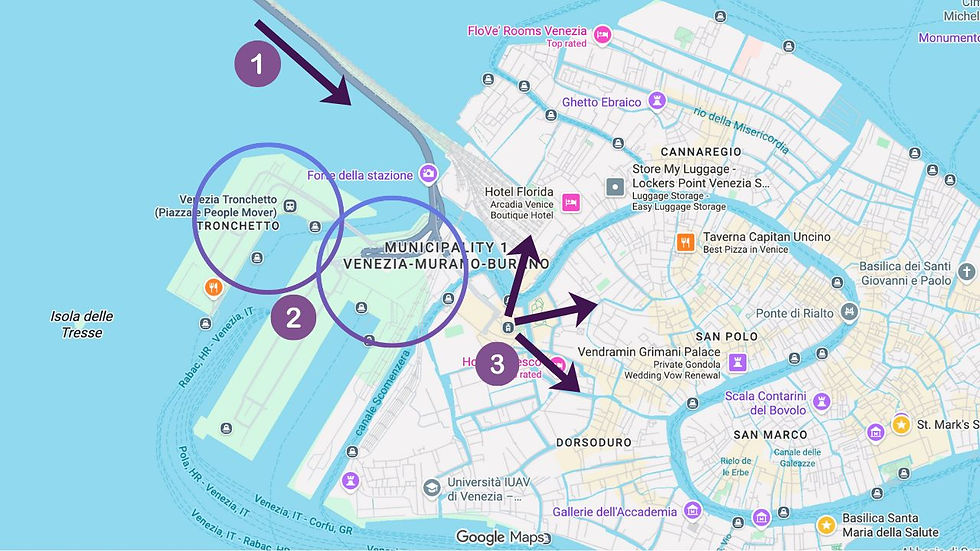
If you arrive by car, you will leave it behind at Piazzale Roma or Tronchetto. Both have large parking garages designed for visitors. I recommend Piazzale Roma as it is a bit closer to the 'entrance' of the Venice canals. The parking spot for a day costs from 25 to 35 Euros. So (as per picture below) you cross the big bridge that leads to Venice's historic center, park on the right side at one of the parkings, and then head to Piazzale Roma from where you can then explore Venice as you prefer.
Getting Around Venice

Once you’re in Venice, walking is the default. And honestly, it’s the best way to experience the city. You cross small bridges, get lost in narrow streets, and stumble onto quiet squares without planning it. Venice rewards slow wandering. I walked everywhere in Venice, and if you can, I think it is the best way, otherwise you spend so much time queuing for the water transports.
If you do need to get from A to B that are far from each other or maybe another island, then as I mentioned, the public water bus, called vaporetto is the cheapest way. It’s the city’s water bus and the main form of public transport. It runs along the Grand Canal and connects nearby islands. If you plan to use it more than once or twice, a 24, 48, or 72-hour pass makes much more sense than buying single tickets.
Water taxis exist, but they’re expensive. They’re useful if you’re short on time, traveling with lots of luggage, or arriving late at night. Otherwise, they’re more of a splurge than a necessity.
And then there are gondolas. They’re iconic, slow, and definitely not cheap. This is not transport. It’s an experience. If you’ve always dreamed of it, do it once and enjoy the moment. I didn't need to use one, but it has been my dream ever since I started planning a trip to Venice, so I purely used it for the experience. By the canal, it is easy to find them. Just look out for gondola stations around the city. A 30-minute ride costs 90 Euros. Yes, expensive, but I believe it was worth the experience. A longer rides start from 110 Euros.
Where to Stay in Venice
This might be a controversial opinion, but I believe the best is not to stay on the actual island. If you are planning to stay in Venice for a week or more, then maybe. But if you are visiting for a day or two, I think it is way more convenient to stay on the mainland, in one of the towns near the main road. Let's look at the map to have a better understanding ⬇️

So the red exclamation mark in the triangle indicates where is the final place where you can get with a car, train, or bus. If you have suitcases, it will become way more difficult to travel. Plus, there are so many people, I would try to avoid 'public transport' and walk everywhere. I walked through the whole of Venice and enjoyed it way more, because it was sightseeing at the same time. I took the boat only once for the experience, but not as a means of transportation. So I would recommend staying in Tessera, which is very conveniently located by the airport. Ideal if you are visiting for a day on your bigger Italy/Euro trip. Then also Bagaron/Campalto, because you want to be near the big main road taking you from the airport to Venice island. The bus goes there every 15 minutes and costs around 2 euros. And of course, more hotel options you will find in Marghera.
Must See and Do in Venice
Piazza San Marco

Piazza San Marco is where Venice shows off. It’s the city’s main square and the place almost everyone passes through at least once. As soon as you step in, it feels grand, open, and a little unreal. The scale is bigger than most Venetian spaces, and that contrast is part of the magic.
This is where you’ll find St. Mark’s Basilica, the Doge’s Palace, and the Campanile rising above it all. Even if you don’t go inside anything yet, just standing in the square is an experience.

St. Mark’s Basilica feels overwhelming in the best way. Gold mosaics cover almost every surface, glowing softly even on cloudy days. The mix of Byzantine, Gothic, and Roman influences makes it unlike any other church in Italy. It tells the story of Venice as a powerful trading city that pulled beauty from many worlds and made it its own.
The Doge’s Palace is Venice’s historic power house. For centuries, it was the residence of the Doge, the leader of the Venetian Republic, and the center of government and justice. You’ll notice the ornate Gothic facade as soon as you step into Piazza San Marco. Inside, grand halls and chambers tell stories of politics, diplomacy, and daily life in old Venice. Highlights include the Hall of the Great Council and the famous Bridge of Sighs, which once connected the palace to the prisons. Visiting feels like stepping into a chapter of history. Most visitors spend about 1.5 to 3 hours inside, and booking tickets in advance helps skip long lines, especially in high season.
You can get a combined ticket that includes both above and more sites, making it a better deal.
If you want the best view in Venice, the Campanile Bell Tower is it. The Campanile rises above Piazza San Marco and gives you a full panorama of rooftops, canals, and the lagoon stretching into the distance. You don’t climb stairs here. An elevator takes you straight to the top, which makes it an easy stop even on a busy day. The entry ticket is around 25 Euros.
Early morning or late evening is when Piazza San Marco is at its best. Fewer people, softer light, and a calmer mood. During the day, it gets busy, but it’s still worth it. This is Venice’s living room, and everything else seems to orbit around it.
Grand Canal

The Grand Canal is Venice’s main artery. It curves through the city like a slow river, lined with palaces that quietly show off centuries of wealth and history.
Riding the vaporetto here is the smart choice. It’s affordable, practical, and gives you the same views as a gondola, just without the price tag. Gondolas are romantic and iconic, but more about the moment than transport.
Even locals never seem bored with this canal. The light changes. The water shifts. Venice always looks a little different from here.
Rialto Bridge and Rialto Market
The Rialto Bridge is one of those places that feels familiar even before you see it. Elegant, busy, and right over the Grand Canal, it has been the heart of Venice’s trading life for centuries.
Go early in the morning if you can. Before the crowds arrive. Just next to it, Rialto Market comes alive with locals buying fresh fish, fruit, and vegetables. It’s one of the best places to see everyday Venice in action.
Dorsoduro Neighborhood
Dorsoduro feels like Venice taking a deep breath. It’s calmer, more local, and perfect when you want to slow down after the busy sights. Fewer souvenir shops. More students, artists, and quiet corners by the water.
This area is home to the Peggy Guggenheim Museum, one of the best places in Venice for modern art. Even if museums aren’t your thing, the canal-side walk nearby is worth it.
Wander without a plan here. Cross small bridges. Sit by the water. Dorsoduro is Venice at an easier pace, and that’s exactly the charm.
Basilica Santa Maria Della Salute is one ofthe first things you notice when you arrive by boat. Sitting right at the entrance of the Grand Canal, it feels open, calm, and quietly powerful. The interior is simple but elegant, and the views outside are just as good. It’s free to enter, which makes it an easy and rewarding stop while wandering the Dorsoduro area.
Riva Degli Schiavoni
Riva degli Schiavoni is one of the easiest places in Venice to slow down. This wide waterfront promenade stretches along the lagoon, just east of Piazza San Marco, with boats gliding past and sea air always in the background.
It’s perfect for a relaxed walk, especially in the early morning or around sunset. You get open views of the lagoon, small islands in the distance, and that classic Venice feeling without squeezing through narrow streets. Sit on a bench, watch the water, and let the city breathe for a moment.
Castello District
Castello District is one of the city’s largest neighborhoods, but also one of the least touristic. You’ll notice it right away. Fewer souvenir shops. More locals going about their day.
Walk without a plan here. Small squares. Quiet canals. Local bakeries and bars that haven’t changed in years. It’s the perfect area to wander when you want to see everyday Venetian life, away from the crowds of the historic center.
Venetian Cooking Class
A cooking class is one of the most hands-on ways to understand Venice. You shop for ingredients, learn traditional techniques, and cook dishes that locals actually eat. Think fresh seafood, seasonal vegetables, and simple recipes done well. It’s a nice break from sightseeing and crowds. You slow down, sit at a table, and connect with the city through food. Plus, you leave with skills you can recreate long after the trip is over.
Venice Carnival
Venice Carnival is when the city fully leans into its theatrical side. Masks take over the streets. Costumes turn every square into a stage. For a few weeks in February, Venice feels like it’s floating between reality and fantasy.
You’ll see traditional masks inspired by centuries-old designs, elegant balls, and spontaneous performances in public squares. It’s beautiful, crowded, and intense. Expect higher prices and packed streets, but also a once-in-a-lifetime atmosphere that feels uniquely Venetian.
A great way to see and learn more about Venice is with a free walking tour!
Best Time To Visit Venice
June to August is the peak season. The weather is hot, the city is packed, and prices are at their highest. Venice is still beautiful, but it takes patience and early mornings to enjoy it.
April to May and September to October are the sweet spots. The weather is pleasant, crowds are lighter, and walking the city feels far more relaxed. This is when Venice shows its best side.
November to January brings fewer tourists and lower prices. The weather can be moody and unpredictable, but the city feels calmer and more local.
February is Carnival season. It’s magical, colorful, and unforgettable. It’s also busy, loud, and expensive. Worth it if Carnival is on your bucket list.
FAQs Venice Travel Tips
Is Venice Worth Visiting Despite The Crowds?
Yes, especially if you explore early mornings, quieter neighborhoods, and travel outside peak months.
How Many Days Do You Need In Venice?
Two to three days is ideal for first-time visitors in Venice. Enough to see the highlights and enjoy the Venice vibe.
Is Venice Expensive For First-time Visitors?
It can be, but walking, churches, neighborhoods, and vaporetto passes help keep costs reasonable.