


Singapore Travel Guide: Best Places to Visit & Things to Know
Updated: Oct 20
Singapore is one of the top destinations I have ever been to! I loved Singapore, I loved everything about this country!
It is, without doubt, one of the cleanest and most organised places I have ever visited. What impressed me most was the mix of cultures, religions, and traditions living side by side. I loved seeing how different communities contribute to the country's unique identity.
I must admit, Singapore is quite an expensive travel destination compared with many other Asian countries, but it is definitely worth visiting. And if you plan carefully, you can still enjoy Singapore without spending a fortune.
In this guide, I'm sharing my favourite places to visit in Singapore, how to get around, where to stay, and useful travel tips to help you plan your trip.
How to Get to Singapore
How to Get Around Singapore
Best Things to See and Do in Singapore
Singapore's Cultural Neighbourhoods
Singapore’s Interesting History
Is Singapore Expensive?
Where to Stay in Singapore
How Many Days Do You Need in Singapore?
Best Time to Visit Singapore
Important Things to Know Before Visiting Singapore
Video
How to Get to Singapore
Travelling to Singapore is relatively easy, with three main options: air, sea, or land.
By air: The most popular option is flying into Singapore Changi Airport, one of the world's most impressive airports. With beautiful gardens, entertainment facilities, and the famous Jewel Changi Airport complex, it's practically an attraction itself!
By sea: Singapore is also a major cruise destination, with cruise terminals including Marina Bay Cruise Centre Singapore.
By land: If you're travelling from Malaysia, you can enter Singapore through the Woodlands or Tuas checkpoints.
How to Get Around Singapore
Singapore has an excellent public transport system, and I would recommend using the MRT (Mass Rapid Transit) to travel between neighbourhoods. It's fast, affordable, clean, and connects most of the main attractions.
Buses are another convenient option. You can generally pay for public transport using a supported contactless bank card or mobile wallet, or purchase an EZ-Link card.
Taxis are also available, although from my personal experience, I found it surprisingly difficult to catch one directly on the street. Booking through a ride-hailing app is often easier.
There are also hop-on hop-off sightseeing buses, which can be useful if you have limited time and want to visit the main landmarks.
Best Things to See and Do in Singapore
Marina Bay and Marina Bay Sands

Marina Bay is one of Singapore's most famous tourist areas, and I would describe it as very fancy and expensive!
Here you'll find the iconic Marina Bay Sands, one of the most recognisable hotels in the world. The hotel is famous for its spectacular rooftop infinity pool overlooking the city. However, the pool is reserved for hotel guests. Visitors who aren't staying at the hotel can enjoy the views from the paid SkyPark Observation Deck.
There is also an enormous shopping centre, The Shoppes at Marina Bay Sands, filled with luxury brands, restaurants, and entertainment.
One thing I definitely recommend is watching Spectra, the free outdoor light and water show at Marina Bay Sands. The show usually takes place at:
Sunday - Thursday: 8 PM and 9 PM
Friday - Saturday: 8 PM, 9 PM, and 10 PM
Check the latest schedule on the official Marina Bay Sands website.
Gardens by the Bay — My Favourite Place in Singapore!
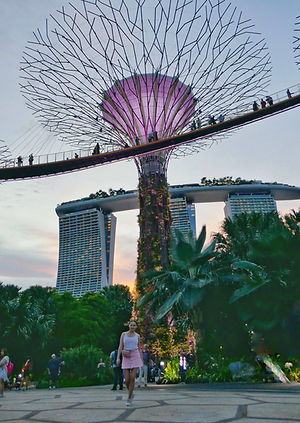
For me, the most spectacular place in Singapore was Gardens by the Bay! The enormous futuristic Supertrees are incredible during the day, but the real magic happens in the evening when they light up during the Garden Rhapsody show.
One of the most beautiful moments of my trip was watching the light show from the OCBC Skyway, the elevated walkway connecting some of the Supertrees. Honestly, it was that good! The light and music show normally takes place twice each evening, at 7:45 PM and 8:45 PM.
The best part is that you can watch Garden Rhapsody for free from the Supertree Grove. However, the OCBC Skyway requires a separate ticket and has its own operating hours, so you shouldn't assume you can access it during the show.
If you want to explore the other attractions, including the Flower Dome and Cloud Forest, I'd recommend allowing several hours. You could easily spend half a day here!
Check tickets, opening hours, and the latest show information on the Gardens by the Bay website.
Haji Lane — My Favourite Place for Atmosphere
When researching Singapore, you'll often see Clarke Quay recommended for its restaurants and evening entertainment. However, my personal favourite was Haji Lane!
I loved the atmosphere here. It's a colourful little street filled with street art, quirky shops, funky cafés, and restaurants. It's lively during the day and has a completely different energy in the evening. Another reason I liked it was that it felt more affordable than some of the fancier areas around Marina Bay.
For food, I really enjoyed Blu Jaz. The food was delicious, the portions were generous, and the prices were reasonable compared with many other places I visited in Singapore.
If you enjoy discovering colourful neighbourhoods with character, definitely add Haji Lane to your itinerary!

Visit the Famous Raffles Hotel
During my trip, I also managed to visit the famous Raffles Hotel. Opened in 1887, this historic luxury hotel is one of Singapore's best-known landmarks. It's particularly famous for its colonial-era architecture and its association with the Singapore Sling, a cocktail traditionally credited to bartender Ngiam Tong Boon in the early 20th century. Even if you're not staying at the hotel, it's an interesting place to visit for its history and architecture.
MacRitchie Reservoir Park
If you want to escape the busy city and enjoy some nature, MacRitchie Reservoir Park is a wonderful option. Singapore is surprisingly green, and MacRitchie is one of the best places to experience its tropical forests. There are beautiful walking trails, reservoir views, and opportunities to spot wildlife, including macaques.
One of the best-known attractions is the TreeTop Walk, a suspension bridge offering views over the forest canopy. Access involves a longer walk, so make sure you have enough time and check whether the bridge is open before visiting.
MacRitchie is accessible by public transport, making it a great nature escape without leaving Singapore.
My tip: Bring water, comfortable walking shoes, and some insect repellent. And if you see monkeys, admire them from a distance without feeding them.
Singapore Flyer
Another famous Singapore landmark is the Singapore Flyer. Opened in 2008, this giant observation wheel stands approximately 165 metres tall and offers spectacular views of Marina Bay and the surrounding city. It's particularly impressive in the evening when Singapore's skyline lights up. The Singapore Flyer is also one of the recognisable landmarks near the Formula 1 Singapore Grand Prix circuit. If you enjoy panoramic city views, it's definitely worth considering!
Singapore's Cultural Neighbourhoods
One of the things I loved most about Singapore was its cultural diversity. Different neighbourhoods have their own architecture, traditions, places of worship, and food, making it feel as though you're exploring several different destinations within one city. Here are the areas I'd recommend visiting.
Little India
Little India is one of Singapore's most colourful neighbourhoods. As you walk through the streets, you'll find beautiful Hindu temples, colourful buildings, flower garlands, traditional shops, and the wonderful smell of Indian food. It's a lively place to explore, especially if you enjoy discovering different cultures through architecture and food. Don't miss the beautiful Sri Veeramakaliamman Temple, one of the area's most recognisable landmarks.
Chinatown
Singapore's Chinatown is another fascinating neighbourhood, filled with traditional shophouses, temples, markets, and restaurants. You'll find a mixture of Chinese cultural heritage and modern city life, with beautiful historic buildings sitting alongside busy shopping streets. Some places worth seeing include the Buddha Tooth Relic Temple and Thian Hock Keng Temple. Chinatown is also a great area for affordable local food!
Kampong Gelam
Kampong Gelam, sometimes called Kampong Glam, is Singapore's historic Malay and Muslim cultural district. It dates back to the early 19th century and was once associated with Malay royalty. Today, it's known for its beautiful Sultan Mosque, traditional shops, colourful streets, and modern cafés. This is also where you'll find Haji Lane, one of my favourite places in Singapore! I'd recommend combining both in the same visit.
Civic District and Boat Quay
Singapore's historic Civic District is home to some of the city's most impressive colonial-era buildings. Here you'll find landmarks such as the former Supreme Court and City Hall buildings, now part of the National Gallery Singapore.
Nearby, Boat Quay was once an important trading area along the Singapore River. Today, its restored shophouses are home to restaurants and cafés, making it a lovely area for a walk along the waterfront.
Singapore’s Interesting History
Singapore has a fascinating history that helps explain how it became the modern country we see today. The island was already connected to regional trading networks centuries before the arrival of the British. In 1819, Stamford Raffles established a British trading post, which contributed to Singapore's growth as a major commercial port. During World War II, Singapore was occupied by Japan from 1942 until 1945. It later gained self-government in 1959, joined Malaysia in 1963, and became an independent country in 1965. Since independence, Singapore has transformed into one of the world's most developed economies, investing heavily in infrastructure, public housing, education, and transport. I think knowing a little about this history makes exploring the different neighbourhoods even more interesting.
Is Singapore Expensive?
It's no secret that Singapore is one of the more expensive destinations in Southeast Asia. Accommodation, particularly around Marina Bay and the central business districts, can be costly. However, I don't think you need an enormous budget to enjoy Singapore!
Some of the best experiences are completely free, including walking around Marina Bay, exploring the cultural neighbourhoods, and watching the Gardens by the Bay light show.
My Tips for Visiting Singapore on a Budget
Eat at hawker centres. Singapore is famous for its hawker food culture, and you can find delicious local meals at much lower prices than in many restaurants.
Use public transport. The MRT is convenient and much more affordable than relying on taxis.
Enjoy the free attractions. Some of my favourite experiences, particularly the light shows and cultural neighbourhoods, don't require expensive tickets.
Choose your accommodation carefully. Staying outside Marina Bay can make a significant difference to your budget.
Where to Stay in Singapore
Singapore has excellent public transport, so you don't necessarily need to stay right next to the main attractions. Here's a quick comparison of the areas I'd recommend considering.
Area | Best for |
Luxury hotels, iconic views, and major attractions | |
First-time visitors, restaurants, culture, and convenient transport | |
Food, cultural attractions, and a range of accommodation options | |
More budget-friendly stays and a lively local atmosphere | |
Shopping and upscale hotels |
My recommendation: I'd choose Bugis or Chinatown for a first visit. Both offer convenient transport connections, plenty of places to eat, and a good location for exploring Singapore.
If you're looking for a luxury experience and your budget allows it, Marina Bay is an excellent option.
How Many Days Do You Need in Singapore?
I'd recommend spending 3 - 4 days in Singapore to enjoy the main attractions without rushing. You could see the highlights in two days, but I think Singapore deserves a little more time, especially if you want to explore its different cultural neighbourhoods.
Here's how I would organise a short visit:
Day | What to see |
Day 1 | Marina Bay, Marina Bay Sands, Gardens by the Bay, and the evening light shows |
Day 2 | Little India, Kampong Gelam, Haji Lane, and the Raffles Hotel area |
Day 3 | Chinatown, Civic District, Boat Quay, and Singapore Flyer |
Day 4 | MacRitchie Reservoir Park or additional attractions of your choice |
Best Time to Visit Singapore
Singapore has a tropical climate, meaning it's hot and humid throughout the year. Temperatures don't change dramatically between seasons, but rainfall patterns do.
February to April can be a good period for sightseeing, although rain is still possible.
November to January generally brings more rainfall due to the northeast monsoon.
Personally, I wouldn't worry too much about finding the perfect month. Singapore is a year-round destination, and many attractions can be enjoyed even when the weather isn't ideal. Just bring light clothing, comfortable shoes, and an umbrella!
Important Things to Know Before Visiting Singapore
A few practical things worth knowing:
Singapore is very clean and organised. Respect local rules, particularly around littering and public transport.
Public transport is excellent. You can easily explore most of the city without renting a car.
The local currency is the Singapore dollar (SGD).
English is widely spoken, making Singapore an easy destination for international travellers.
Tap water is safe to drink, so bring a reusable water bottle.
The weather is hot and humid. Plan some indoor breaks between sightseeing activities.
Check entry requirements before travelling. Most visitors must submit the free SG Arrival Card within three days before arrival, and visa requirements depend on nationality.
I feel like I can’t describe this amazing country well enough in words, so better to watch this video as it shows more of the beauty and fantastic vibe of this place!
FAQ: Singapore Travel Guide
Is Singapore worth visiting?
Absolutely! Singapore is one of my favourite destinations in Asia. I loved its cleanliness, organisation, beautiful architecture, cultural diversity, and incredible attractions.
How many days do you need in Singapore?
I'd recommend 3 - 4 days to explore the main attractions, cultural neighbourhoods, and Gardens by the Bay without rushing.
Is Singapore expensive for tourists?
Singapore is generally more expensive than many other Southeast Asian destinations, particularly for accommodation. However, public transport, hawker centres, and free attractions make it possible to visit on a more affordable budget.
What is the best area to stay in Singapore?
Bugis and Chinatown are great options for first-time visitors because of their convenient transport connections, restaurants, and proximity to major attractions. Marina Bay is ideal for a luxury stay.
What is the best way to get around Singapore?
The MRT is the easiest and most convenient way to travel around Singapore. Public buses are also reliable, and many attractions are within walking distance of MRT stations.
Is Gardens by the Bay free?
You can visit several outdoor areas, including Supertree Grove, for free and enjoy the Garden Rhapsody light show without a ticket. However, attractions such as the OCBC Skyway, Cloud Forest, and Flower Dome require paid admission.
Can you drink tap water in Singapore?
Yes! Singapore's tap water is safe to drink, so you can refill your water bottle instead of constantly buying bottled water.
Is Singapore good for a stopover?
Definitely! Changi Airport is a major international hub, and Singapore's efficient public transport makes it relatively easy to explore the city during a longer stopover. Just make sure you have enough time and meet the entry requirements.
More articles from Southeast Asian countries:
Metro Manila Travel Guide, the Philippines 🇵🇭 🏙️
Sagada & Banaue Rice Terraces, the Philippines 🇵🇭 🌱
El Nido, a must-visit in the Philippines 🇵🇭 🥥🌴🐠
Coron, a beautiful island in the Philippines 🇵🇭 🏝️
Taal Volcano, still an active volcano in the Philippines 🇵🇭 🌋
Intramuros, Spanish vibes in the Philippines 🇵🇭 🌻
Is Bali worth visiting? 🇮🇩 ☠️

